What Does Onboarding Look Like Without Documented Processes?
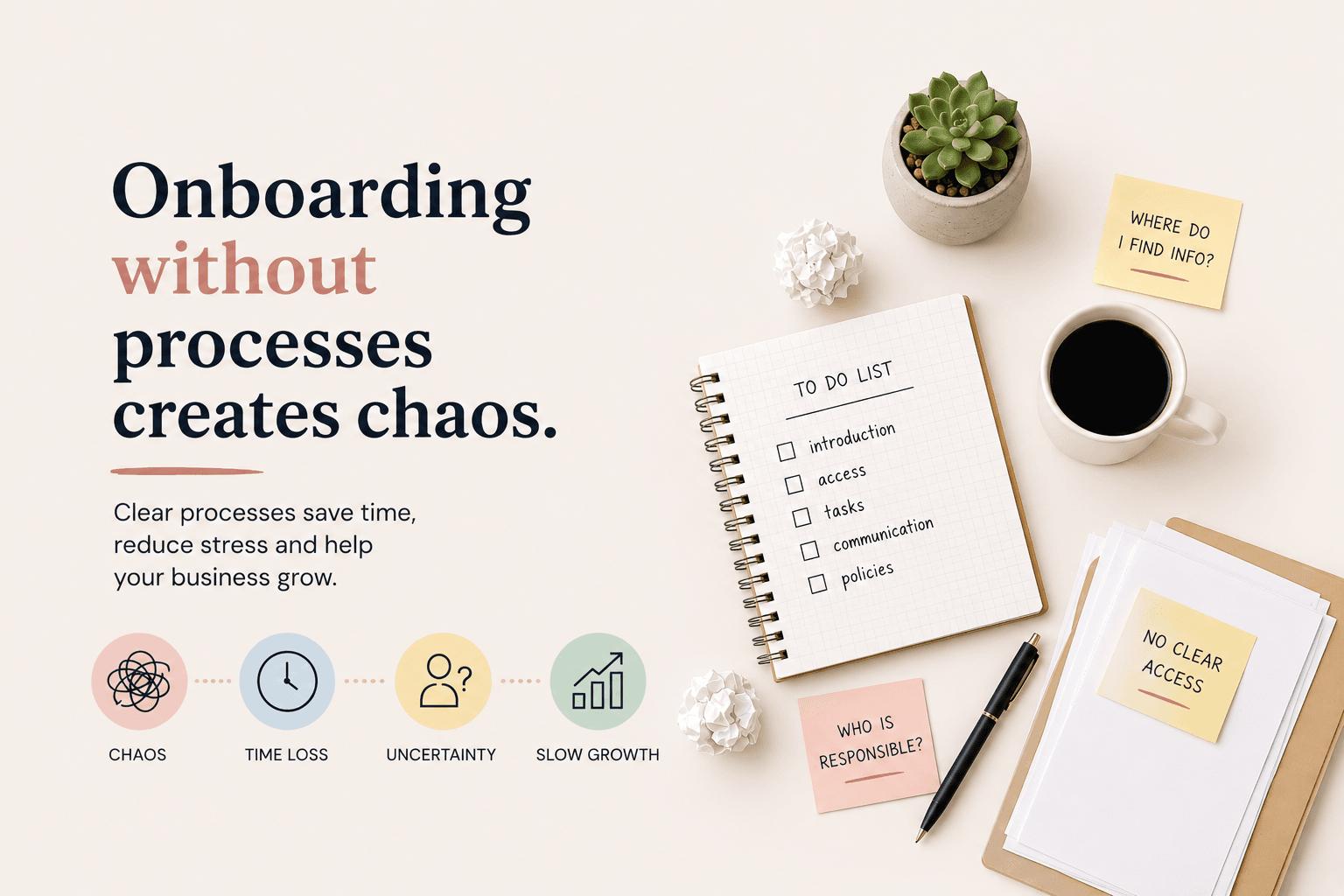
Small and medium-sized business owners often don’t have a dedicated HR department, which means hiring and onboarding processes can become somewhat chaotic and informal. However, even without an HR team, it’s possible to implement simple processes that improve organization and optimize daily operations.
In this article, virtual assistant Ivana Borgudan explains what onboarding looks like when processes are not documented, the challenges this creates in everyday work, and what businesses can introduce to make onboarding clearer, faster, and more consistent.
Over the past few years, virtual assistants have become increasingly present in the market. These professionals provide a wide range of remote services, from administrative and customer support to digital marketing, HR, and recruitment. For small and medium-sized businesses, they represent a practical alternative to an in-house HR department and recruitment team — one that can be equally effective and often more cost-efficient.
Onboarding Without Documented Processes vs. Onboarding With Documented Processes
1. Onboarding Without Documented Processes
Whenever hiring a new employee, it is essential to clearly define the job description, responsibilities, and the value those responsibilities bring to the business. If expectations and offerings are not clearly defined from the start, businesses risk losing candidates, spending additional time on recruitment, and increasing hiring costs.
Once goals and expectations are clearly established, it is equally important to ensure that onboarding is successful for both the new employee and the existing team.
When processes are not clearly defined, it usually means:
a) Improvisation
The new employee struggles to adapt and is unsure who to ask for help or information.
Instructions are mostly given verbally by colleagues.
Access to data, equipment, and tools is not prepared in advance and is instead handled ad hoc.
b) Team Introduction
Meeting colleagues happens spontaneously, without a clear explanation of roles and responsibilities.
The management structure and chain of responsibility are unclear, so employees do not know who to turn to or who monitors their progress.
c) Undefined Work Tasks
There is no task list or progress plan.
The new employee is expected to “learn on the go” and frequently relies on colleagues for support.
Expectations and priorities are not clearly communicated.
d) Post-Onboarding Follow-Up
There is no structured follow-up during the following weeks and months, with the assumption that the employee will simply learn everything over time.
New employees often feel left on their own because they must actively search for information; instructions are unclear and inconsistent, while feedback is usually received only after mistakes happen.
e) Learning Processes and Rules
Employees struggle to access information, everything is handled ad hoc, and learning often comes down to trial and error.
Standard operating procedures and documentation are frequently incomplete or do not exist at all.
When we look at the lack of documented processes, it becomes clear how significantly this can impact the entire business. Employees often feel frustrated because information is difficult to access and insecure because feedback usually arrives only after mistakes are made, creating a cycle of repeated errors. When employees are stressed and lack essential information, the risk of mistakes increases and the adjustment period becomes longer. “Unwritten rules” and knowledge stored only within individuals make scaling and continuity much more difficult.
2. Onboarding With Documented Processes
Documented processes not only help businesses avoid chaos during onboarding but also reduce unnecessary costs. With documented processes, onboarding becomes structured, predictable, and efficient. New and existing employees alike know what to expect, how to perform tasks, and who to ask for support. When employees have clear structures and processes, problems are solved more quickly and overall satisfaction improves, positively impacting business stability.
When processes are documented and clearly defined:
a) Organized Onboarding
From day one, the new employee receives a clear schedule, including company introduction and administrative tasks.
Access to data, equipment, and tools is prepared in advance, allowing the employee to begin working immediately.
The employee receives guidelines covering essential procedures and rules.
b) Introduction to the Team and Organization
The employee is introduced to the team, roles, responsibilities, and management structure.
A mentor is assigned to support the employee during the first days.
Documented procedures make it easier to understand who is responsible for what and how processes function.
c) Planned Work Tasks
The employee receives an onboarding plan with tasks, goals, and deadlines for the first few weeks.
Because processes are documented, employees can independently track what needs to be done and how.
Employees have access to reference documentation for most questions, while mentors and team members remain available for support.
d) Progress Tracking and Evaluation
Employee progress is regularly monitored during the first weeks and months.
Employees receive structured feedback aligned with documented goals.
New employees clearly understand expectations and can track their own progress.
e) Learning Processes and Rules
Documented procedures cover daily tasks, internal tools, communication guidelines, rules, and company values.
Employees always have access to guides and standards.
Reliance on “unwritten knowledge” and specific individuals is significantly reduced.
Benefits of Documented Processes:
- Consistency: every employee goes through the same clearly defined process.
- Faster and more efficient onboarding: clear tasks, materials, and expectations make adaptation easier.
- More empowering work environment: employees better understand their role, goals, and ways of working.
- Increased productivity: new team members become independently productive more quickly.
- Less stress and uncertainty: everyone knows what is expected of them.
- Better conditions for growth and scalability: onboarding can easily be repeated for larger teams.
- Legal and organizational consistency: documents and procedures are presented uniformly.
- Easier process monitoring and optimization: weaknesses are identified and improved faster.
Conclusion
Documented onboarding processes are important regardless of business size. Their absence often leads to chaos, instability, and frustration, which negatively affects both the organization and its employees.
If you want to bring more structure to your onboarding processes, consider hiring a virtual assistant specialized in HR and recruitment. Virtual assistants are external collaborators you can engage based on your needs — for short-term projects or long-term support — often at a lower cost than hiring an in-house HR professional.
Want to Improve Your Business and Increase Efficiency?
GoThrive brings together a trusted community of virtual assistants specialized in various business areas, from administrative support and customer service to marketing and HR. You can quickly and easily find a virtual assistant who matches your needs and business goals. Join the GoThrive community and gain professional support that saves you time, money, and energy.
Ivana Borgudan is a virtual assistant with nearly 20 years of professional experience gained in Croatia and Ireland. She has worked across multiple industries, including logistics, sales, recruitment, and property maintenance, building experience in sales, administration, HR, and operations departments. Through virtual assistance, she helps entrepreneurs improve processes and save time on tasks they can and want to delegate. She specializes in administrative support, email and calendar management, and recruitment. If you are looking for an assistant who can add real value to your business, you can contact her with confidence at: ivana.northstar.va@gmail.com